Make the people in your life feel truly heard
Everyone remembers the conversation that went sideways — the one you replay at 2am, rewriting your lines. Deeper Dialogues exists so the next one goes differently.
It teaches the thing nobody taught you: how to listen so people open up, ask questions that actually land, and say the hard thing without torching the relationship.
Being heard is not a personality trait. It's a skill.
Most of us wing our most important conversations. We rehearse arguments in the shower, say "fine" when we're not fine, and save the real conversation for the car ride home — alone, at full eloquence, three hours too late.
Deeper Dialogues replaces winging it with craft. It draws on established frameworks — Marshall Rosenberg's Nonviolent Communication, Dr David Rock's SCARF model of social threat, and the app's own BRIDGE method for difficult conversations — and turns them into something you can actually do on a Tuesday, with a real person, while your heart is pounding.
And because knowing about listening is not the same as listening, the app is built around practice: labs, planners, drills, and a rehearsal studio where you can have the hard conversation with an AI playing the other person — before you have it with the person who matters.
What's Inside
Twelve core modules — six to eight hours in total — in a recommended order that builds from the science of connection to your own signature style. Nothing is locked; start where it hurts.
Why Some Conversations Feel Like Magic
How to Make Anyone Feel Truly Heard
Question Architecture
Reading the Room (And the Person)
The Hard Conversations That Matter Most
Nonviolent Communication
Cross-Cultural Conversations
Building Lasting Connections
Owning the Room Without Dominating It
Fixing What You Broke (Before It's Too Late)
Speaking Truth Without Starting Wars
Your Signature Conversation Style
Six premium add-on packs go deeper into specific territory: The Family You Actually Want · Love That Lasts (Through Real Conversations) · Career-Making Conversations · Building Friendships That Actually Last · Being There When It Really Matters · Talking Money Without the Drama.
Then you practise. A lot.
Deeper Dialogues carries 32 interactive tools — eight core tools, one for each foundation module, plus 24 more across the add-on packs. Alongside them: 100 conversation tips, 869 conversation questions across six relationship categories, 52 weekly challenges, and 16 named micro-techniques like The 3-Second Pause, Reflective Playback and The Repair Attempt.
Connection Science Analyser
Track real conversations and map what actually gives them energy
Active Listening Lab
Interactive exercises that train deep, undistracted listening
Question Architecture Builder
Design questions that open conversations up instead of shutting them down
Emotional Intelligence Navigator
Build emotional awareness you can use mid-conversation
Difficult Conversation Planner
Framework-based preparation for the talk you keep postponing
NVC Practice Studio
Practise Marshall Rosenberg's Nonviolent Communication step by step
Cultural Communication Adapter
Navigate conversations across cultural difference with respect
Relationship Health Tracker
Watch connection quality over time, not just in the moment
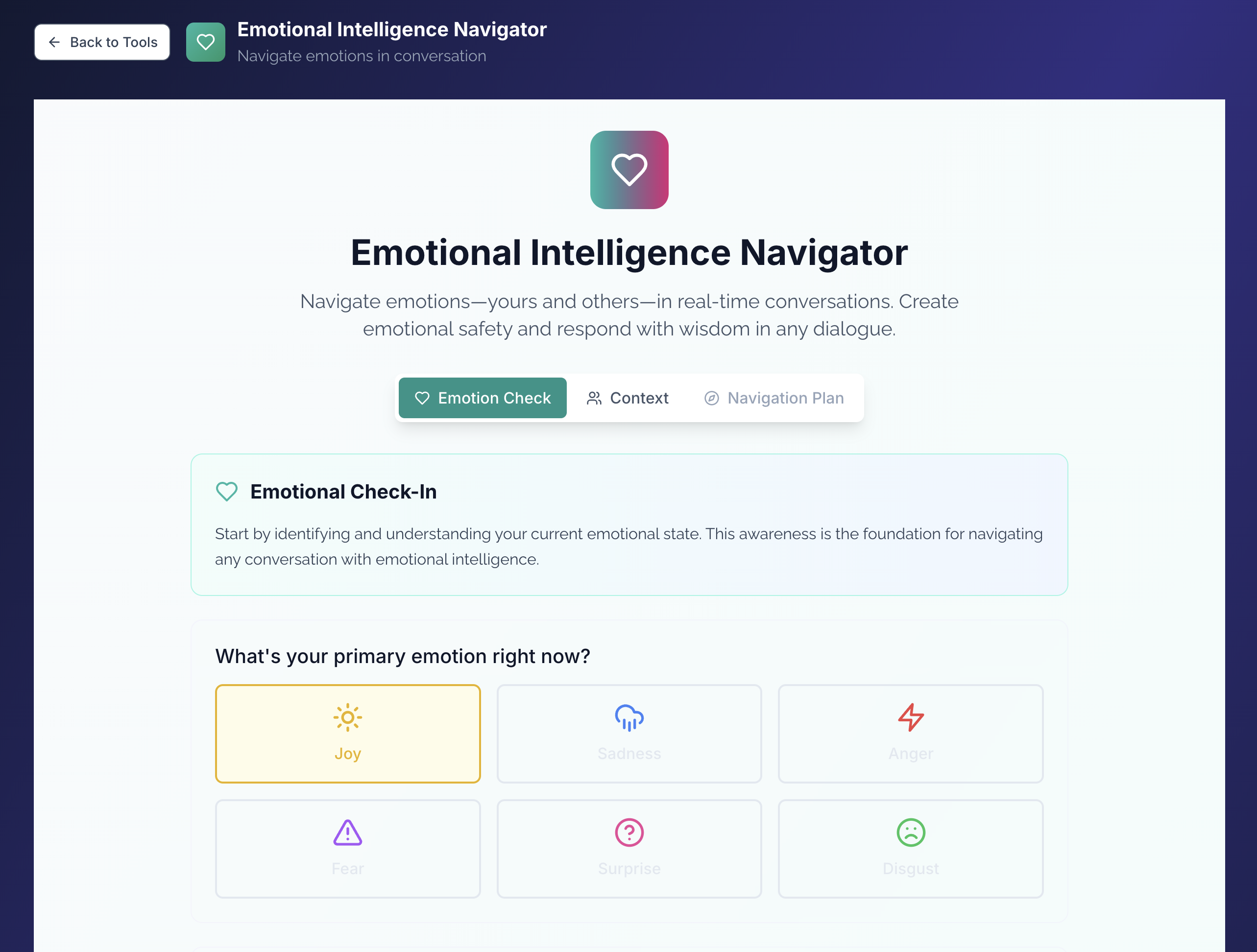
The Emotional Intelligence Navigator — one of the eight core practice tools.
Meet Chatty — your conversation wingmate
Chatty is the app's AI companion. Ask it anything as you learn, or open a coaching session that remembers where you're up to. The app's own words: "Not therapy. Not advice. Just a coach who remembers you."
In the rehearsal studio, Chatty plays the other person across 20 scenarios — family, partner, friends, work, and the genuinely hard ground — at a difficulty you choose. Practise the conversation before it counts.
Who It's For
Deeper Dialogues isn't for one kind of relationship — it's for the moment you catch yourself thinking, "I have no idea how to have this conversation." The app opens with six of them:
"Talking to my teenager"
"The money chat with your partner"
"Supporting a grieving friend"
"Asking for a raise"
"First date nerves"
"Family conflict"
If you're a parent, a partner, a friend, a manager, or simply someone who wants the people around you to walk away from conversations feeling better than when they arrived — this is your app. It's written in plain language, starts at beginner level, and never assumes you were born charming.
Questions People Actually Ask
What exactly is Deeper Dialogues?
Deeper Dialogues is the flagship conversation app from Dive Deep Dialogues. It teaches you how to make the people in your life feel genuinely heard, through 12 core learning modules, 32 interactive practice tools, a communication style assessment and a rehearsal studio where you can practise hard conversations before you have them for real.
How long does the core curriculum take?
The 12 core modules take six to eight hours in total, with each module running 20 to 35 minutes. There is a recommended learning order, but nothing is locked — the path is a suggestion, not a gate, so you can jump straight to the module you need today.
Is this therapy or counselling?
No. Deeper Dialogues is education — practical skills, frameworks and practice. Its AI coaching mode says it plainly: not therapy, not advice, just a coach who remembers you. The app also includes crisis support contacts for seven countries (Australia, New Zealand, the UK, Ireland, Canada, India and the USA), because some conversations need a professional, and the app is honest about that.
Who is Chatty?
Chatty is the app’s AI conversation wingmate. You can ask questions as you learn, open a coaching session that remembers where you are up to, or use the rehearsal studio, where Chatty plays the other person across 20 scenarios — from a withdrawn teenager to a tense money conversation — at a difficulty you choose. Coaching sits behind a consent gate, and you can export or delete your data at any time.
Do I need to be a confident talker already?
Not at all. The curriculum starts with why conversations work — the science of what makes people feel heard — before it asks you to change anything. The first two modules are built for beginners, and the communication style assessment shows you your natural strengths before you start.
What does the communication style assessment tell me?
It walks you through 13 real-life scenarios — a grieving friend, a workplace conflict, a tense family dinner — and identifies your primary style out of six: Empathetic Supporter, Analytical Problem-Solver, Direct Communicator, Harmonious Peacekeeper, Inquisitive Explorer or Supportive Encourager. It takes about five minutes, needs no sign-up, and recommends the modules and tools that fit how you already communicate.
The next hard conversation is coming either way.
You can wing it again — or you can walk in knowing exactly how to help the other person feel heard.
Part of Dive Deep into Conversation · See all our apps